Using the wrong power supply with your Raspberry Pi is a recipe for disaster—corruption, crashes, and that dreaded low-voltage warning (the flashing lightning bolt icon). The GeeekPi 5V 3.6A Power Supply with On/Off Switch promises proper power delivery at a budget-friendly price, with the added convenience of an inline switch. At around £8-11, it positions itself as an affordable alternative to the official Raspberry Pi power supply. But does it deliver stable, reliable power, or will you be troubleshooting voltage issues? Let’s plug in and find out.
Key Specifications
Power Output:
- Input: 100-240V AC, 50/60Hz (worldwide compatibility)
- Output: 5V DC, 3.6A
- Power: 18W
- Connector: USB Type-C (for Pi 4)
Design Features:
- Inline ON/OFF toggle switch (unlabeled)
- Extended cord length: 120cm (4 feet)
- High-quality copper wire core
- Inline noise filter
- Heavy-duty construction
Safety Certifications:
- UL Listed Certification
- TUV Certification
- RoHS Certification
- FCC Compliant
Multi-Protection Functions:
- Over-voltage protection
- Under-voltage protection
- Over-temperature protection
- Over-current protection
- Short circuit protection
Compatibility:
- Raspberry Pi 4 Model B (1GB/2GB/4GB/8GB)
- Raspberry Pi 3 Model B+ (with included adapter)
- Raspberry Pi 3 Model B (with included adapter)
- Orange Pi 5/5B/5 Plus
Package Includes:
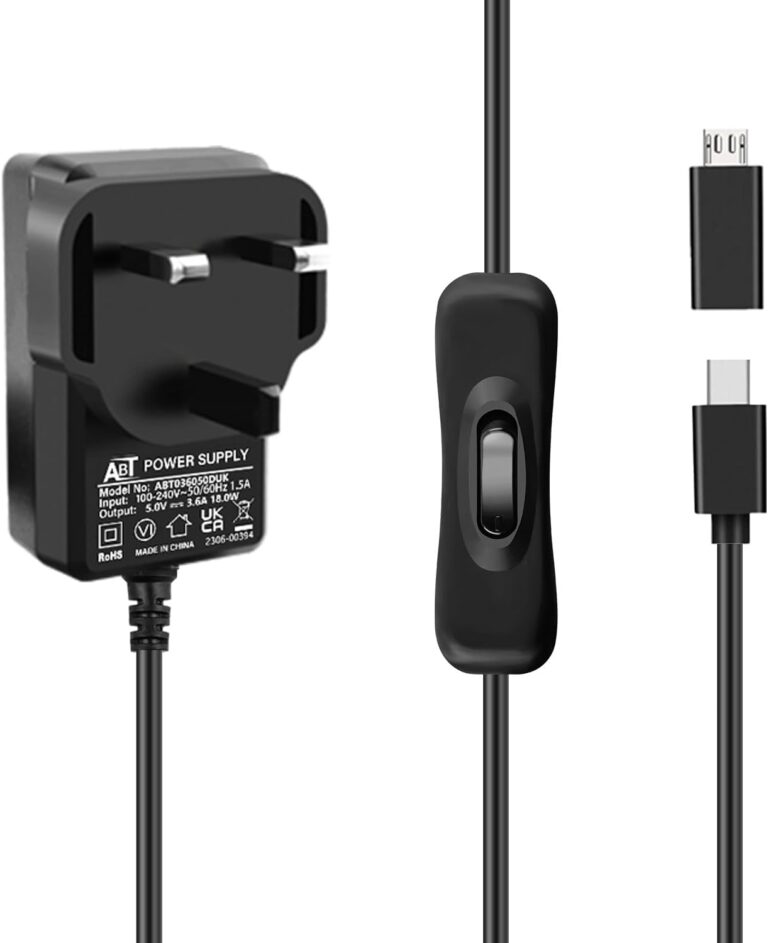
- 1x 5V 3.6A UK plug power supply with ON/OFF switch
- 1x USB Type-C to Micro USB adapter (for Pi 3B+/3B compatibility)
Price: £8-11 (typically £10.99 RRP)
The Game-Changing Feature: The Inline Switch
Why a Switch Matters
The standout feature that elevates this power supply above generic alternatives is the inline ON/OFF toggle switch. While it might seem like a minor addition, users consistently cite this as the most valuable aspect of the product.
The inline switch is a simple but incredibly useful addition that allows users to turn the Pi off without unplugging it, which is a real time-saver and makes things much more convenient, especially when testing or tinkering with projects.
Practical Benefits:
- No more plug/unplug wear: Constant plugging and unplugging wears out both the power connector and the Pi’s USB-C port
- Safer shutdowns: Proper software shutdown followed by switch-off prevents SD card corruption
- Convenient reboots: Easy power cycling for troubleshooting without reaching behind equipment
- Remote installations: Essential for Pi setups in hard-to-reach locations
- Multiple Pi projects: Quickly switch between different Pi boards without swapping cables
The toggle switch design allows users to see what position it’s in before plugging in the Pi, providing visual confirmation of the power state—a small but appreciated detail.
Power Delivery Performance
Adequate Power for Pi 4
The 5V 3.6A (18W) specification provides sufficient power for Raspberry Pi 4 boards across all RAM configurations. This exceeds the Pi 4’s official requirement of 5V 3A (15W), providing a comfortable power margin.
Users report that after switching to this power supply, the low-voltage warning (flashing lightning bolt) that appeared with inadequate phone chargers disappeared completely. The proper power delivery prevents:
- SD card corruption from voltage drops
- Unexpected crashes and reboots
- USB device disconnections
- Performance throttling
- System instability
Voltage Stability
Independent testing shows the power supply maintains tight voltage tolerances, with minimal load voltage at 5.2V, 3A voltage at 4.9V, and under-volt cutoff at 4.8V. These measurements demonstrate proper voltage regulation within acceptable limits.
The high-quality copper wire core and inline noise filter contribute to stable transmission, ensuring your Pi receives clean, consistent power even during load fluctuations.
Real-World Usage
Multiple users confirm reliable operation across various applications:
- 24/7 server operation: Pi-hole ad blockers and home servers run continuously without issues
- Media centers: Kodi and similar applications with HDMI output and USB peripherals
- Development work: Consistent power during programming and testing sessions
- GPIO projects: Stable voltage for electronics projects and sensor arrays
Build Quality and Construction
Heavy-Duty Design
The switch and cord are well-constructed and feel very heavy-duty, instilling confidence in the product’s longevity. The power supply uses quality materials throughout:
- Copper wire core: Superior conductivity compared to aluminum alternatives
- Thick insulation: Durable outer sheathing protects internal wiring
- Solid switch mechanism: Toggle switch feels robust with positive on/off action
- Quality connectors: USB Type-C plug fits snugly without excessive force
Extended 120cm Cable
The 120cm (4 foot) cable length provides flexibility for various setups without being excessively long. This is particularly useful for:
- Desk setups where the power outlet is below or behind the desk
- Entertainment center installations
- Wall-mounted Pi projects
- Prototyping benches with distant power sources
The cable length strikes a good balance—long enough for convenience, but not so long that excess cable becomes unmanageable.
Included Micro USB Adapter
The inclusion of a USB Type-C to Micro USB adapter extends compatibility to older Raspberry Pi models (3B+ and 3B). Users successfully power their Pi 3B+ with the adapter supplied, finding it provides more than enough power and includes the very convenient power switch.
However, some users note the adapter seems a bit flimsy and may not hold up well with frequent movement of the device while connected, recommending delicate handling. The adapter is best suited for semi-permanent installations rather than frequent swapping.
Safety and Protection Features
Multi-Layered Protection
The GeeekPi power supply includes comprehensive protection mechanisms that safeguard both the power supply itself and connected devices:
- Over-voltage protection: Prevents damage from voltage spikes exceeding safe limits
- Under-voltage protection: Cuts power before voltage drops low enough to cause corruption
- Over-temperature protection: Shuts down if internal components overheat
- Over-current protection: Prevents excessive current draw that could damage the Pi
- Short circuit protection: Immediately cuts power if a short circuit is detected
These protections are particularly valuable for educational environments, experimental projects, or situations where accidental shorts might occur.
Professional Certifications
The power supply holds multiple safety certifications:
- UL Listed: Meets North American safety standards
- TUV Certified: European safety compliance
- RoHS Compliant: Restriction of Hazardous Substances directive
- FCC Compliant: Electromagnetic interference standards
These certifications provide assurance that the product has been independently tested and meets international safety standards—something budget power supplies often lack.
Compatibility Across the Pi Ecosystem
Raspberry Pi 4 Model B (Primary)
The power supply is specifically designed and tested for the Raspberry Pi 4 across all memory configurations:
- 1GB RAM version
- 2GB RAM version
- 4GB RAM version
- 8GB RAM version
All versions perform identically with this PSU, receiving adequate power for full performance.
Raspberry Pi 3 Models (With Adapter)
The included USB Type-C to Micro USB adapter enables use with:
- Raspberry Pi 3 Model B+
- Raspberry Pi 3 Model B
The 3.6A output is actually overkill for Pi 3 models (which only require 2.5A), providing an extra power margin for USB peripherals and ensuring zero voltage issues.
Orange Pi Compatibility
The power supply is also compatible with Orange Pi single-board computers:
- Orange Pi 5
- Orange Pi 5B
- Orange Pi 5 Plus
This cross-compatibility makes it a versatile choice if you work with multiple SBC platforms.
Pros and Cons
Advantages
✅ Inline ON/OFF switch – Game-changing convenience for everyday use
✅ Adequate power delivery – 3.6A exceeds Pi 4 requirements with headroom
✅ Eliminates low-voltage warnings – Proper power prevents corruption and crashes
✅ Multi-protection features – Comprehensive safety mechanisms
✅ Professional certifications – UL, TUV, RoHS, FCC compliant
✅ Extended 120cm cable – Excellent length for most setups
✅ Quality construction – Heavy-duty feel with copper wiring
✅ Tight voltage tolerances – Stable 5V delivery under load
✅ Includes Micro USB adapter – Backwards compatible with Pi 3 models
✅ Affordable pricing – Significantly cheaper than official PSU
✅ Inline noise filter – Clean power delivery
✅ Universal voltage input – Works worldwide (100-240V)
Disadvantages
❌ Switch unlabeled – No markings indicating on/off position
❌ Adapter feels flimsy – Micro USB adapter may not withstand frequent movement
❌ Basic circuit design – May experience voltage drift as components age
❌ Occasional reliability concerns – Some units fail within 18 months
❌ No LED indicator – Can’t visually confirm power status
❌ Plain appearance – Functional but unremarkable aesthetics
❌ Temperature sensitivity – Performance may vary with ambient temperature
❌ Not suitable for high-stress scenarios – Better alternatives exist for demanding applications
Longevity and Reliability
Mixed Long-Term Performance
While most users report excellent reliability, one user noted that after purchasing three units, one failed after a year and a half, with voltage dropping from 5V to 3.21V. This suggests that while the majority of units perform well, quality control isn’t perfect.
For critical applications or projects where power supply failure would be catastrophic, consider:
- Purchasing a spare unit
- Opting for a premium power supply with better long-term reliability guarantees
- Implementing a UPS (Uninterruptible Power Supply) for mission-critical systems
Expected Lifespan
The simple circuit design may be prone to temperature sensitivity and component drift over time, suggesting that while the initial performance is solid, long-term stability could be a concern for some units.
Realistic expectations:
- Typical lifespan: 2-3 years of regular use
- Best-case scenario: 5+ years in light-duty applications
- Worst-case scenario: Failure within 12-18 months (rare but possible)
Comparison with Alternatives
vs. Official Raspberry Pi 4 Power Supply (£8-10)
Official PSU Advantages:
- Specifically engineered for Pi 4
- Guaranteed long-term reliability
- Better quality control
- Endorsed by Raspberry Pi Foundation
GeeekPi Advantages:
- Inline switch (official lacks this)
- Similar pricing
- Higher current rating (3.6A vs 3A)
- Includes adapter for Pi 3 compatibility
Verdict: The GeeekPi’s switch makes it more practical for daily use, despite the official PSU’s reliability edge
vs. CanaKit Pi 4 Power Supply with PiSwitch (£12-15)
CanaKit Advantages:
- Premium build quality
- Dedicated external switch module
- Better long-term reliability
- Aesthetic design
GeeekPi Advantages:
- 25-40% lower price
- Integrated switch design (no extra module)
- Similar power delivery
Verdict: CanaKit is worth the premium for professional or long-term projects; GeeekPi is better value for hobbyists
vs. Generic USB-C Phone Chargers (£3-6)
Phone Charger Advantages:
- Slightly cheaper
- Already owned by many users
- Compact size
GeeekPi Advantages:
- Proper voltage regulation prevents warnings
- On/off switch
- Safety certifications
- Pi-specific design and testing
- Prevents corruption and system instability
Verdict: Never use phone chargers for Pi 4—the £5-7 price difference isn’t worth the headaches
Who Should Buy This Power Supply?
Ideal For:
- Hobbyists and makers working with Raspberry Pi 4 projects
- Students and educators needing reliable power for Pi labs
- Anyone experiencing low-voltage issues with inadequate PSUs
- Multi-Pi users who benefit from convenient power switching
- Budget-conscious buyers wanting proper power at affordable prices
- Pi 3 and Pi 4 owners who appreciate the included adapter
- Tinkerers and developers frequently power cycling during testing
Consider Premium Alternatives If:
- You need guaranteed 5+ year lifespan
- Building mission-critical or commercial systems
- Want the absolute best voltage stability
- Prefer external switch modules over inline design
- Willing to spend 50-100% more for marginal reliability improvement
Final Verdict
Rating: 4/5 Stars ⭐⭐⭐⭐
The GeeekPi Raspberry Pi 4 Power Supply with On/Off Switch is an excellent value proposition that successfully balances affordability, functionality, and reliability. While it doesn’t match the premium build quality of more expensive alternatives, it delivers where it matters most: stable power delivery and everyday convenience.
The inline switch transforms the user experience, making power management effortless and eliminating the wear and tear of constant plugging and unplugging. Combined with proper power delivery that eliminates low-voltage warnings, multi-protection features, and professional certifications, this PSU punches well above its £8-11 price point.
Yes, there are reports of occasional long-term failures, and the circuit design may not age as gracefully as premium alternatives. However, for the vast majority of users—hobbyists, students, home automation enthusiasts, and casual Pi users—this power supply will serve them faithfully for years.
The inclusion of safety protections and certifications provides peace of mind that you’re not risking your Pi with a no-name power brick. The universal voltage input, extended cable, and Pi 3 compatibility adapter add further value to an already attractive package.
Bottom Line: If you want reliable power delivery with the convenience of an on/off switch without breaking the bank, the GeeekPi power supply is an outstanding choice. It may not be “buy it for life” quality, but it’s more than good enough for most Raspberry Pi applications at a price that won’t hurt your wallet.
Bottom Line
Best for: Pi 4 users, hobbyists, students, anyone needing convenient power switching
Skip if: You need guaranteed premium longevity or mission-critical reliability
Price: £8-11 (exceptional value)
Our Verdict: Smart design meets solid performance at a budget-friendly price
Buy on Amazon : https://amzn.to/47dSnxt
Stop using phone chargers and give your Raspberry Pi the power it deserves! Have you experienced the convenience of a switched power supply? Share your thoughts in the comments!