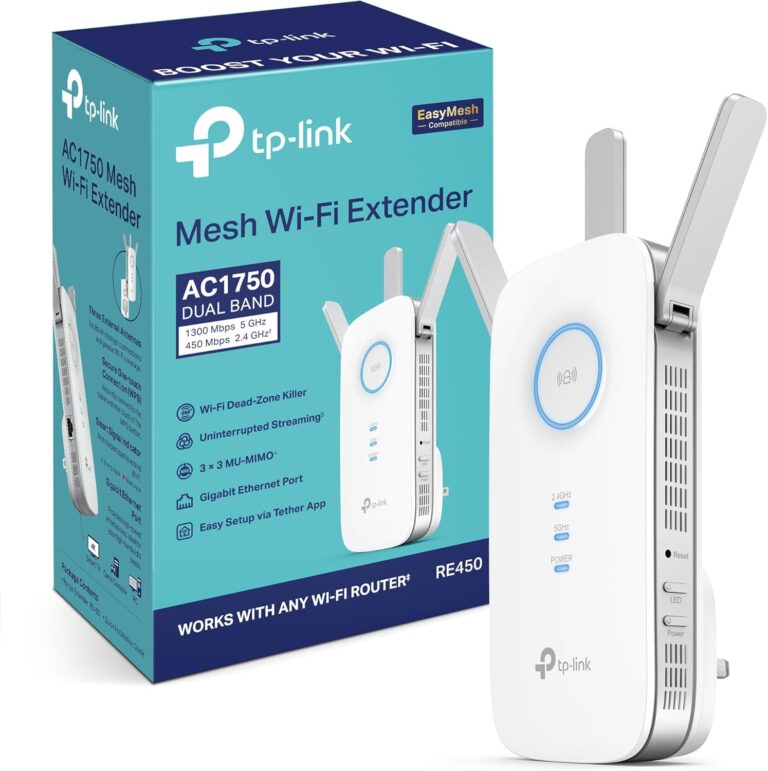
The TP-Link RE450 AC1750 WiFi Extender earned PCMag’s Editors’ Choice award for delivering stellar performance at £40-50, featuring dual-band AC1750 speeds (450Mbps on 2.4GHz + 1300Mbps on 5GHz), three external antennas, and a Gigabit Ethernet port.
Buy On Amazon: https://amzn.to/4niiIAK
Independent testing shows it maintained 98-100% connection at distances up to 150 feet, featuring dual-band AC1750 speeds (450Mbps on 2.4GHz + 1300Mbps on 5GHz), three external antennas, and a Gigabit Ethernet port. Independent testing shows it maintained 98-100% connection at distances up to 150 feet, and users report it extended WiFi to far regions of large homes with acceptable speeds and seamless connections. However, performance is uneven—you might get excellent coverage in some areas while others prove disappointing, and some Windows 10 users experience compatibility issues despite manufacturer claims. The bulky wall-plug design lacks a pass-through outlet, blocking adjacent sockets. For homes under 500Mbps internet plans, it’s a powerful solution, but those needing consistent reliability across all locations should consider mesh systems.
Rating: 3.5/5 Stars ⭐⭐⭐☆
Performance Strengths and Setup Experience
Setup is incredibly simple—users press the WPS button on their router and the extender, watch lights flash momentarily, and setup completes in seconds. The three adjustable antennas and front-facing LED signal indicators help optimize placement for maximum coverage. Real-world testing at five feet showed WiFi speeds of 291.56 Mbps wirelessly and 458.02 Mbps via Ethernet, making it suitable for HD streaming and moderate gaming. The extender reached impressive distances of 60-70 feet, covering entire homes including multiple floors, backyards, and garages. The Gigabit Ethernet port provides versatility for connecting wired devices like smart TVs or gaming consoles, and access point mode allows hardwired connections to routers for maximum stability. However, performance inconsistency remains problematic—more affordable models like the TP-Link RE210 deliver more consistent results even at slower speeds.
Why Users Choose This:
- Professional-grade range – Users report rock-solid performance placed on upstairs landings, achieving full signal strength in all rooms of semi-detached houses with zero complaints from non-technical family members
- Speed for demanding applications – Apartment dwellers with thick concrete walls across three split levels report speeds exceeding expectations, solving slow internet problems in distant living rooms
Deal-Breaker Issues:
- Windows 10 compatibility problems – Multiple users report the RE450 works perfectly with iPhones but refuses to connect with Windows 10 PCs despite latest firmware, with over an hour of technical support calls failing to resolve the issue
- Blocks adjacent outlets – The bulky, top-heavy design lacks a pass-through outlet and is wide enough to prevent using neighboring sockets, plus it’s easily knocked down by pets or passersby
Comparison & Purchase Recommendation
| Feature | TP-Link RE450 | TP-Link RE305 | Netgear EX6120 |
|---|---|---|---|
| Price | £40-50 | £20-30 | £35-45 |
| Max speed | 1750Mbps (AC1750) | 867Mbps (AC1200) | 1200Mbps (AC1200) |
| Ethernet port | Gigabit | Fast Ethernet | Fast Ethernet |
| Range | 60-70 feet | 40-50 feet | 50-60 feet |
| Performance consistency | Variable | Good | Good |
| Outlet blocking | Yes | Minimal | Yes |
| Windows 10 issues | Reported | Rare | Rare |
Who should buy this: Homeowners with large properties, thick walls, or multi-story layouts who need maximum range and can position the extender strategically. Mac and mobile device users will experience fewer compatibility headaches. Those with internet plans between 200-500Mbps get the best value—faster plans may not fully utilize the speeds, while slower plans won’t notice the premium performance. The TP-Link RE450 excels when you can dedicate a wall outlet specifically to it and don’t need the socket for other devices.
Buy On Amazon: https://amzn.to/4niiIAK
Who should avoid this: Windows 10 users should exercise caution due to documented connectivity problems with no guaranteed resolution. Anyone needing reliable, consistent performance across every room should invest in mesh WiFi systems like TP-Link Deco or Google Nest WiFi. If you need the adjacent wall socket for other devices, the blocked outlet makes this impractical. Renters with limited outlet options or homes with complex layouts causing unpredictable signal behavior will find mesh systems more foolproof despite higher costs.
Need to extend your WiFi range without running cables? The RE450 delivers impressive distance and speed—when it works consistently. What’s been your experience with WiFi extenders versus mesh systems?